
The deployment of autonomous AI agents in enterprise environments has precipitated a product specification problem of substantial consequence — one that most product organizations have not yet confronted with the rigor it demands. Agentic systems are failing in production at a rate incommensurate with the maturity of the underlying models, and the predominant cause is architectural rather than algorithmic. Enterprise AI product managers are, by and large, designing at the prompt level while their systems operate at the loop level. That divergence does not manifest as model degradation. It manifests, instead, as autonomous systems taking consequential, often irreversible action on specifications that were never formally articulated.
That specification deficit has a precise name: the agent loop. The enterprise AI product managers who cannot formally define it are, by extension, shipping autonomous systems whose full behavioral envelope they do not adequately understand.
The thesis of this post is unequivocal: prompt engineering is a craft. Agent loop design, however, is architecture. As an enterprise AI product manager, you are very likely investing substantive effort in the former while the latter operates without your intentional design. This post, therefore, gives you the architectural vocabulary, the design framework, and the six questions that constitute your minimum specification standard before any agentic feature ships.
What Is an Agent Loop?
The distinction that matters most in enterprise AI
The agent loop is not a metaphor or a loose analogy for autonomous behavior. It is, specifically, the deterministic runtime architecture of an autonomous AI agent. The loop is a structured, repeating cycle that governs every decision and consequential action the agent executes.
The loop is not the model. The model is a single component inside the loop. The loop, however, is the orchestration architecture that coordinates the model across multiple steps, propagates context, executes tools, and evaluates progress toward a defined goal. The conflation of these two constructs is, in fact, the most prevalent specification error in contemporary enterprise AI product work.
In enterprise deployments, the scale of what happens inside the loop is non-trivial. A single user instruction — “process this invoice” — may consequently trigger fifteen to forty loop iterations before a result is returned. The model fires in each iteration. The loop, moreover, governs all of them.
Why your failure calculus has changed?
This distinction is consequential, specifically, because a model failure and a loop failure are categorically different problems. A model failure is a quality issue: the output is wrong. A loop failure, by contrast, is a systemic issue. Your agent took the wrong action in your ERP, your supplier system, or your financial ledger. The consequences, moreover, may be non-recoverable before any human intervention is possible.
The agent loop is, therefore, the architecture that makes that interactive operation consequential at enterprise scale. Until you have a working model of the loop, you are not specifying your agentic product. You are specifying one component of it. The remainder, consequently, operates outside the scope of your intentional design.
The Architecture of Agent Loop that Every AI Product Manager Needs to Internalize
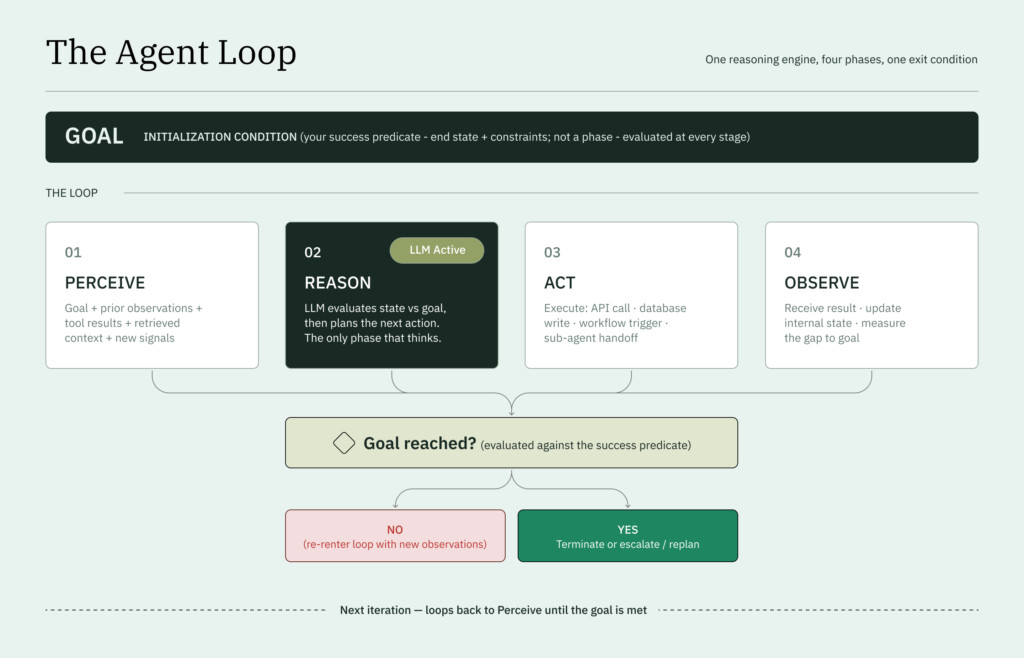
The agent loop has five components. Four of them form the repeating cycle. One, however, sits above the cycle and governs every iteration of it. The diagram below maps the complete architecture.
The Goal — Your Initialization Specification
Before the loop begins, the agent receives a goal. A goal is not a prompt. A prompt is an instruction — it tells the agent what to do in a single call. A goal, by contrast, is a success predicate: a precise definition of what “done” looks like, including the end state and the constraints under which it must be reached. In the diagram above, Goal sits above the four phases as the initialization anchor. It is not a phase. It is the condition every iteration evaluates against.
In enterprise systems, specifically, the orchestration layer translates natural language requests into a structured goal before the loop initializes. Every iteration then evaluates progress against that goal. Delineating that goal specification is, notably, a non-delegable responsibility — it is not the LLM’s province, and it cannot be defaulted to engineering.
“Check this invoice” is a prompt. “Validate this invoice against the open PO, vendor payment history, and AP policy; flag anomalies; do not release payment; escalate if variance exceeds five percent; stop and log exception if PO cannot be found” — that is a goal. Without a precisely articulated goal, your agent is left without a principled termination criterion — and an agent without a termination criterion is, architecturally, an unbounded process.
The Four Phases of Agent Loop
Perceive is the agent’s intake mechanism. At the start of each iteration, the agent consolidates everything available to it: the goal carried forward from initialization, the result of the prior action, retrieved documents, policy records, memory artifacts, and any new signals. This is not prompt-reading. It is a structured aggregation of multi-modal inputs across the full context of the current loop state. What the agent is allowed to perceive — and from which sources — is a specification decision you must define.
Reason is the only phase in which the LLM is active. The model evaluates the perceived state against the goal predicate and determines the next action: invoke a tool, request clarification, return a result, delegate to a sub-agent, or iterate again. The quality of this decision is predicated on what the Perceive phase surfaces — and on the precision of your goal specification. Perceive, Act, and Observe are all infrastructure. Reason is the sole point of intelligence in the cycle.
Act is the execution phase. The agent carries out the decision produced by Reason: an API call, a database write, a workflow trigger, a communication dispatch, or a sub-agent handoff. No intelligence is applied here — only the consequential, real-world execution of what Reason determined. Irreversible actions occur in this phase, which is precisely why your tool permission architecture and human checkpoint design must formally govern it.
Observe closes each iteration. The agent receives the result of its Act-phase execution and updates its internal state before the next cycle begins. Observe determines how proximate the agent is to the goal state. If the goal predicate is satisfied, the loop terminates. If not, the updated state flows into the next Perceive phase, and the cycle restarts. What the agent retains across this boundary — and what it discards — is your state management specification.
Prompt Engineering vs Agent Loop – Three Categorical Differences
This is not a critique of prompting. Prompt engineering is, notably, a legitimate and consequential craft that produces measurably superior outputs from individual model calls. It is not, however, your primary design discipline as an enterprise AI product manager. That distinction carries significant practical implication.
Prompting operates on the Reason phase. It shapes how the LLM thinks in a single iteration. The loop, however, determines what your LLM reasons about, how many times, and with what real-world consequences. You cannot, specifically, prompt your way to a well-specified loop.
A prompt defines an instruction. A goal, by contrast, defines a success condition. These are architecturally distinct artifacts. Designing one without the other presupposes a specification completeness that does not, in fact, exist. The failure surfaces, moreover, are categorically different. A bad prompt produces a wrong answer. A misconfigured loop, however, precipitates a wrong action — executed autonomously in your ERP or your financial ledger, often with consequences that are non-recoverable.
| Dimension | Prompt Engineering | Agent Loop Design |
| Scope | Single LLM call | Multi-step, multi-turn cycle |
| State | Stateless | Stateful across iterations |
| Your design surface | Instruction text | Architecture, tools, memory, termination |
| Failure consequence | Wrong answer | Wrong action — cascading, often irreversible |
| Your artifact | Prompt template | Loop spec, goal predicate, tool permission model |
What the Shift Means for You?
Note the column headers in the table above. Your design surface is not the instruction text — it is the architecture: tools, memory, goal predicate, termination logic. Your design artifact is not a prompt template. It is a loop specification.
Great prompt engineers design better model thoughts. As an enterprise AI product manager, however, you design better systems. Enterprise AI needs both disciplines — in their correct positions. The AI product manager who operates exclusively at the prompt level is, consequently, specifying the engine while leaving the vehicle entirely undesigned.
Agent Loop moved your Accountability Boundary
From Interaction Layer to Decision Layer
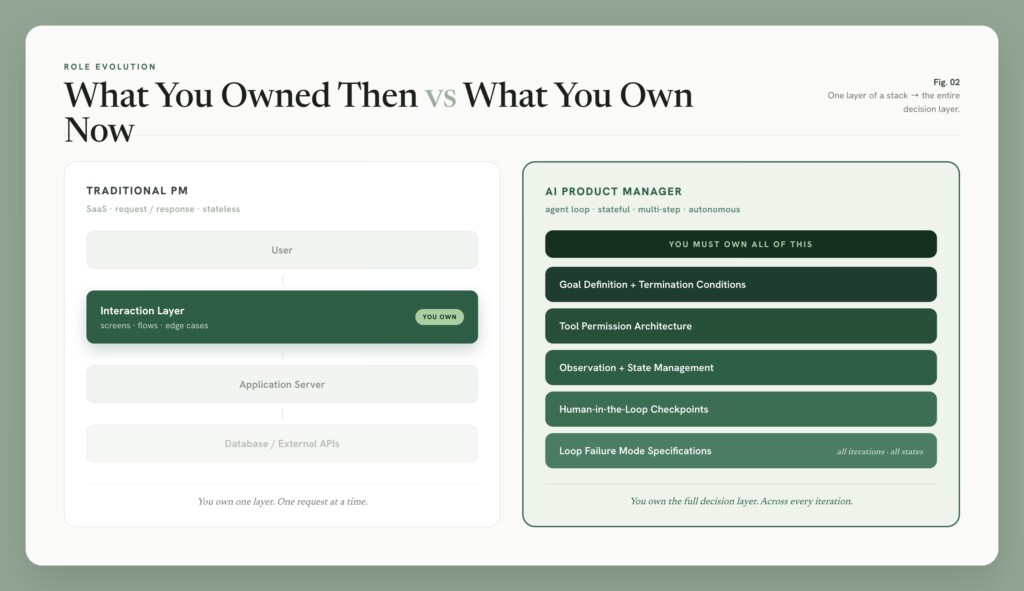
In conventional SaaS product management, the accountability boundary was relatively well-delineated. You owned the user interaction layer — screens, flows, and the edge cases visible within that surface. Engineering owned the system behavior beneath it. That demarcation was viable, however, because each user action was discrete and largely independent of prior state.
Agentic product design breaks that contract fundamentally. The decisions and actions that occur between human touchpoints are neither visible to the user nor specified by engineering. They emerge from the loop — from the compound interaction of your goal definition, your tool access model, your observation specification, and your termination conditions. These are, unambiguously, product specifications. None, moreover, have a credible engineering owner unless you articulate them first.
As illustrated above, your design surface in an agentic system is not one layer. It is the entire decision architecture operating between the user’s instruction and the system’s output. That shift, consequently, is not incremental. It is categorical.
Temporal Complexity — The Design Challenge With No Antecedent
The loop, moreover, introduces a design challenge with no meaningful antecedent in conventional product management: temporal complexity. The decision your agent makes at iteration seven depends on observations accumulated from iterations one through six. No individual step explains the outcome. The loop does. And the loop is, therefore, your design surface.
The length of that leash is your product decision. In enterprise S2P environments, an under-specified loop precipitates duplicate purchase orders and dispatches unintended supplier communications. Moreover, it auto-approves contracts in contravention of policy — all before a human touchpoint is reached. This is not, therefore, a technology defect. It is a product specification failure. If your PRD does not formally delineate loop behavior, you have shipped an incomplete product design.
The agent loop is to agentic products what the user story was to SaaS — the foundational unit of design accountability, without which you are not specifying a product but merely a component.
Four Loop Decisions Only the AI Product Manager Can Make
Engineering can implement the answers to these four decisions. You, however, must formulate them — before the sprint begins, before architectural choices are locked, and before your agent is provisioned with access to production systems.
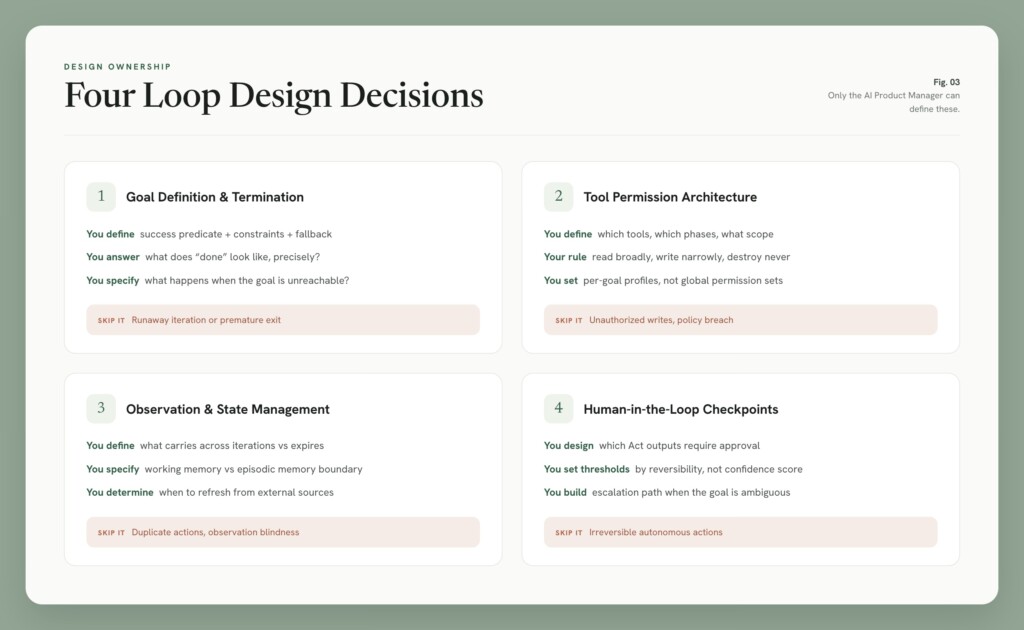
Decision 1 — Goal Definition and Termination Conditions
Termination is goal evaluation. Your agent stops when its current state satisfies your goal predicate. If your goal specification is vague or underspecified, the agent is left without a principled termination criterion. Two failure modes follow as a direct corollary. First, premature termination occurs when the goal condition is too loose — the agent exits before completing the task. Second, runaway iteration occurs when the goal is undefined or unreachable, and your agent loops indefinitely, accumulating consequential real-world actions.
Your goal specification must encode three things. First, the desired end state. Second, the constraints under which it must be reached. Third, the fallback — what your agent does when the goal cannot be reached: escalate, stop with an audit entry, or flag for human review. These are, specifically, your decisions to make.
“Contact enough suppliers” is not a goal. “Contact a minimum of five pre-qualified suppliers from the approved vendor list; stop and flag if fewer than three respond within forty-eight hours” — that is a goal. The difference between these two formulations is, specifically, the difference between a runaway agent and one that operates within its intended behavioral envelope.
Decision 2 — Tool Permission Architecture
Which tools can your agent invoke, in which phases, with what access scope? Tool permissions are not binary. Your agent may have read access to the ERP but not write access. It may query vendor payment history but not trigger payment workflows. Furthermore, permissions must be specified per-goal — not established globally. An AP validation agent and a supplier onboarding agent should not share an access profile, even when operating on the same platform. The goal defines the operational scope. You, as the AI product manager, delineate the permissions.
The governing principle is unambiguous: read broadly, write narrowly, and never execute destructive or irreversible actions without explicit human authorization. That principle, however, is not a technical parameter. It is a product decision that must be encoded in your specification before engineering begins.
Decision 3 — Observation and State Management
Between iterations, your agent carries state. Three types matter in enterprise systems. Working memory holds observations from the current loop run. Episodic memory, moreover, holds outcomes from prior runs. Retrieved context includes documents and policies pulled in during the Perceive phase.
The critical failure mode here is, specifically, observation blindness. Your agent re-executes completed steps because you never specified what it must remember. In enterprise workflows, this consequently produces duplicate API calls, duplicate PO submissions, and duplicate payment triggers. The root cause is not an engineering error. You, specifically, did not define what the agent must retain between iterations.
Your specification must address three questions: what observations carry across iterations, which expire after the current run, and what triggers a memory refresh from an external source.
Decision 4 — Human-in-the-Loop Checkpoints
Notably, human checkpoints are not interruptions to the loop. They are designed Act outcomes. “Escalate to human for approval” is a valid, explicit agent action — and for certain action types, it must be mandatory in your specification.
Define checkpoints by action reversibility, not by model confidence. Your AP agent must require human sign-off before releasing payment above a defined threshold. The cost of a false positive in financial systems is asymmetric. Moreover, it is non-recoverable. Confidence scores do not change that asymmetry. Your specification must, therefore, encode approval thresholds by consequence, not by the agent’s self-assessed certainty.
This also requires you to design the escalation path: what does your agent do when the goal state is ambiguous and human input is required? That is, specifically, not a UX question. It is an agent loop specification question.
Five Failures Every AI Product Manager Should Know by Name
Why Production Breaks What Demo Does Not
Agentic systems, notably, demonstrate strong performance in controlled evaluation environments. They fail in production because demos systematically mask loop failure modes. These modes only surface under real-world variability: tool failures, edge-case inputs, unexpected state combinations, and context accumulations your evaluation never approached.
Your obligation, as an enterprise AI product manager, is to formally specify your way past these failure modes before they surface in a post-incident review. Each row in the table below maps a production failure to the specific specification absent from your PRD.
| Failure Mode | What You See in Production | Root Cause | What You Missed in the PRD | What You Need to Add |
| Goal drift | Output diverges from intent across iterations | Goal success predicate is ambiguous | Goal definition lacks precision and constraints | Tighten the success predicate. Add explicit constraints. |
| Runaway iteration | Agent loops without resolution in live systems | No termination or fallback defined | Goal fallback and max-iterations missing from spec | Add max iteration count and explicit escalation trigger. |
| Observation blindness | Agent re-executes completed steps in a cycle | State not carried forward per iteration | State management not defined in your specification | Specify which observations must persist per iteration. |
| Tool cascade failure | Agent acts on false premise after tool error | No error handling in loop spec | Error recovery path absent from your PRD | Define agent behavior for each tool-call failure type. |
| Context window overflow | Agent loses prior state and repeats earlier actions | Memory architecture unspecified | Working vs episodic memory boundary missing from your design | Define memory retention and compression strategy. |
Reading the Specification Deficit
The pattern across all five is consistent. The failure mode is a production symptom. The root cause is a system behavior under pressure. The fourth column, however, identifies the precise specification absent from your PRD. These are, therefore, not defects that engineering failed to intercept. They are specifications you did not write.
Note, specifically, the third column. In every case, the root cause is a system behavior that was predictable, not surprising. The loop was designed to behave exactly as it did. What was missing was a product specification that anticipated the failure mode and encoded a recovery path. If your PRD does not formally address all five, your agent is not production-ready — regardless of its performance in controlled demonstrations.
Six Questions Every AI Product Manager Must Answer Before Shipping
Your Pre-Shipment Quality Gate
The architectural framework above translates directly into a concrete pre-shipment quality gate. These six questions must carry written, reviewed answers before any agentic feature is handed to engineering. They are not engineering questions — they presuppose product judgment about risk tolerance, compliance requirements, and the appropriate scope of autonomous action.
If, however, you cannot answer all six today for your live agents, you have found your product backlog.
- What is the goal state for this agent — precisely, as a success predicate with explicit end state, constraints, and fallback condition defined?
- What is the termination condition, and what does your agent do when the goal state cannot be reached?
- Which actions in this loop are irreversible? Who approves them before the Act phase executes, and at what specific threshold?
- What does your agent do when a tool call fails at iteration seven of a twelve-step workflow — and is that behavior currently in your PRD?
- What is the maximum number of iterations your agent should run before it escalates to a human reviewer?
- Can you trace every Act phase output back to the goal state that initiated it — and produce that trace for a compliance or audit request?
Why These Questions on Agent Loop Cannot Be Delegated
These are, therefore, the questions your engineering team cannot answer for you. They require product judgment: about acceptable risk, about your compliance environment, about where human oversight is non-negotiable and where your agent may act autonomously.
Moreover, these questions have a compounding effect. An inadequately answered Question 1 — a vague goal predicate — will invalidate the answers to Questions 2 through 6. Every downstream specification is, specifically, predicated on a precise understanding of what success looks like. Get the goal wrong, and the entire specification is consequently unsound. Engineering implements the answers. You, as the enterprise AI product manager, are accountable for delineating them.
The Discipline That Defines the Agentic Era
The agent loop is, therefore, the fundamental unit of design accountability for agentic product systems. This is, in fact, an analogous paradigm shift to the one the user story represented for SaaS product management. In both cases, the transition was not from one technique to another but from one design paradigm to another. The enterprise AI product managers who develop rigorous loop design competency will ship systems that are operationally safe, audit-compliant, and genuinely autonomous within their intended scope. The ones who do not will continue shipping agents that perform credibly in controlled evaluation and fail consequentially in production.
Furthermore, the organizations that prove most formidable in the agentic era will not be distinguished by their model selection. Every major enterprise AI platform is converging on the same foundation models. Consequently, differentiation lives one layer up — in the architecture of the loop. It lives in the precision of your goal specification, the rigor of your tool permission model, and the deliberateness of your human checkpoint design.
Your model selection will be commoditised. Your loop architecture will not.
The question is not whether to develop loop literacy. The question, however, is how quickly — and whether you start before or after your next production incident. Which of these six questions can you not answer today for your live agents? That is, specifically, where to begin.
FAQ — Inside the Agent Loop
1. What is an agent loop, and why does it matter for enterprise AI product managers?
An agent loop is the runtime architecture of an autonomous AI agent — the structured, repeating cycle of Perceive, Reason, Act, and Observe that governs every decision the agent takes. It matters because a single user instruction in an enterprise system may trigger fifteen to forty loop iterations before a result is returned. The model fires inside each iteration. The loop governs all of them. As an AI product manager, if you are only specifying the model or the prompt, you are leaving the most consequential layer of your system entirely undesigned.
2. How is an agent loop different from a prompt or a model call?
A model call is stateless and single-turn — you send an input, you receive an output. An agent loop is stateful, iterative, and goal-directed. It runs across multiple iterations, carries observations forward between steps, executes tools, and evaluates progress against a defined success predicate. Prompt engineering operates on one phase of one iteration — the Reason phase. The agent loop governs the entire system: what the LLM reasons about, how many times, and with what real-world consequences.
3. What is the role of the Goal in an agent loop, and who is responsible for defining it?
The Goal is the initialization condition of the agent loop — not one of the four phases, but the success predicate the loop evaluates against on every iteration. Define what “done” looks like, the constraints under which the agent must achieve it, and the fallback when it cannot. Specify the Goal explicitly instead of leaving the LLM to infer it or engineering to implement it. Delineating it precisely is a non-delegable product specification responsibility. If your PRD does not contain a formal goal predicate, your agent has no principled basis for stopping.
4. What are the most dangerous agent loop failures in enterprise production environments?
The five failures that most consistently surface in production are: goal drift, where a loosely specified goal causes cumulative behavioral divergence; runaway iteration, where the absence of a termination condition causes the agent to loop indefinitely; observation blindness, where the agent re-executes completed steps because state is not carried forward; tool cascade failure, where an unhandled API error corrupts all subsequent iterations; and context window overflow, where accumulated observations exceed the model’s context limit and the agent begins operating on incomplete state. Every one of these is a product specification gap, not an engineering defect.
5. How does an agent loop change what an enterprise AI product manager is accountable for?
In SaaS product management, your accountability boundary was the user interaction layer. The agent loop expands that boundary to encompass the full decision architecture operating between human touchpoints — goal definition, termination conditions, tool permission architecture, observation and state management, human checkpoint design, and loop failure mode specifications. None of these are visible to the user. None are owned by engineering unless you define them first. The agent loop is, therefore, to agentic products what the user story was to SaaS: the fundamental unit of your design accountability.
6. How should an AI product manager specify human-in-the-loop checkpoints within an agent loop?
Design human checkpoints as Act-phase outcomes rather than treating them as interruptions to the agent loop. “Escalate to human for approval” is a valid, explicit agent action. Define checkpoints based on action reversibility rather than model confidence scores. An AP automation agent, for example, must require human sign-off before any payment release above a defined threshold, regardless of how certain the Reason phase appears to be. The cost of a false positive in financial systems is asymmetric and non-recoverable. Your specification must encode approval thresholds by consequence, not by the agent’s self-assessed certainty.
7. What is the minimum specification an AI product manager must produce before an agent loop goes to engineering?
Before handing any agentic feature to engineering, define the precise goal predicate, the termination condition and fallback, the irreversible actions and their required approvers, the agent’s behavior when a tool call fails mid-loop, the maximum iteration count before escalation, and whether every Act-phase output can be traced back to the goal that initiated it. Review and validate the answers to these six questions before implementation. If you cannot answer all six, the specification is incomplete and the agent loop is not ready to build.
8. How does agent loop design differ across different enterprise use cases such as AP automation or supplier onboarding?
The agent loop architecture — Perceive, Reason, Act, Observe — is consistent across use cases. What differs substantively is the specification within each component. An AP invoice validation loop requires a goal predicate tied to variance thresholds and payment policy, narrow write permissions scoped to exception logging only, and mandatory human checkpoints before any payment release. A supplier onboarding loop requires a different goal structure, broader communication tool access, and distinct escalation conditions. Define tool permissions, state management rules, and checkpoint thresholds per goal instead of reusing them globally across agent types, even when those agents operate on the same platform.
Some Good Resources on Agent Loop
The Agent Loop Decoded by Oracle
The Art of Loop Engineering by Langchain
How the agent loop works by Anthropic (Claude)