
If you build AI products, you have felt this already. Choosing the model is the easy part. Everyone can call the same frontier models, and those models improve on their own. The hard part is everything around the model. That part has a name, and most roadmaps still ignore it.
The name is harness engineering. It is the discipline of designing the layer that wraps the model. This article explains that discipline for AI product managers. We will define it plainly, show why it drives outcomes, and lay out how to put it on your roadmap.
The term has circulated in agentic-AI circles for a while now. My interest is narrower and practical. I want to explain what harness engineering means for the people who specify and ship these products. Every agentic system I have built turned on these choices, often before I had a name for them.
What harness engineering is
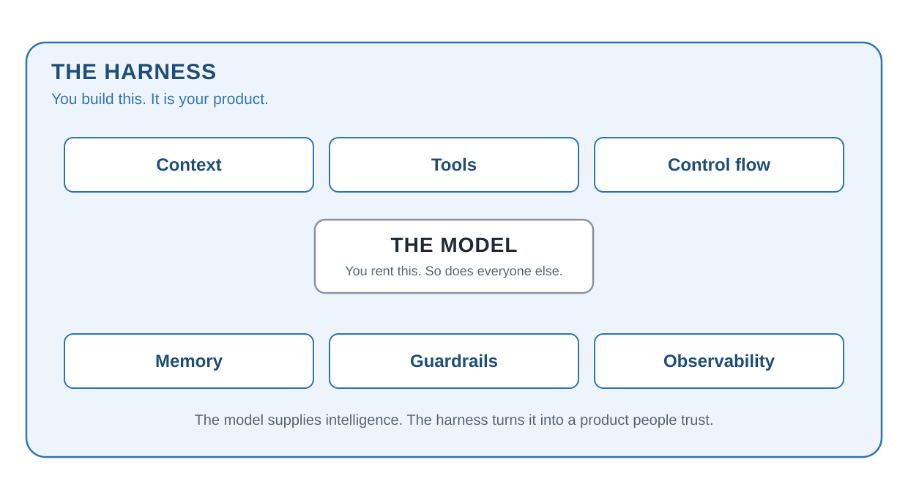
Harness engineering is the deliberate design of everything that wraps the model. It covers context, tools, control flow, error handling, memory, and guardrails. The model supplies raw intelligence. The harness turns that intelligence into a product people can trust.
A quick picture helps – a horse is powerful, yet without reins it runs anywhere it likes. The model is the horse. The harness is the reins. And you are the rider who sets the direction. So the harness sits between the model and the real world. It decides what the agent sees. It decides what the agent can do. And it decides what happens when the agent gets something wrong.
Use cases of Harness Engineering
Two short cases show the difference a harness makes. In each one, the model stays exactly the same. Only the scaffolding around it changes.
| Example Use Case | Problem STATEMENT | How HARNESS ENGINEERING HELPS |
|---|---|---|
| From a winning demo to a system you can trust | In a demo, the agent nails the task every time. In production, the same request drifts. One run pulls stale data. Another forgets a step from earlier in the thread. A third cannot explain why it acted at all. Users notice the wobble, and trust drains quickly. | Here the harness supplies context, memory, and observability. It assembles the right data for each turn. It carries state across the conversation. And it records a readable trace of every decision. So the agent answers consistently and accounts for itself. The capability was always present. The harness made it repeatable. |
| From a clever answer to a safe action | Picture a support agent that can read a customer account and work out the right fix. A raw model often knows that step. Yet it behaves inconsistently. Sometimes it describes the fix, and sometimes it performs it. Worse, it may take a destructive action with full confidence, such as issuing a large refund that needed approval first. | The harness wraps that same model with control flow and guardrails. It validates each action before anything runs. It routes a refund above a threshold to a human, while small actions proceed on their own. So the model’s intent becomes a checked, bounded action. The intelligence did not change. The reliability did. |
How it differs from work you already track
AI product managers already track several adjacent practices. So a fair question follows. How is harness engineering different from the work already on your board?
Prompt engineering tunes the words you send the model. It is one ingredient of the harness, not the whole thing. Context engineering decides what information reaches the model. That sits inside the harness too, as one of its core jobs.
Evaluation, or evals, measures whether the agent does its job well. Think of evals as the test suite for your harness, rather than a separate discipline. Agent orchestration frameworks, such as the popular graph-based libraries, are tools for building a harness. They are not the design decisions themselves.
MLOps is the odd one out. It governs how a model gets trained, deployed, and retrained. Harness engineering instead governs how the agent behaves in production, moment to moment. In short, the harness is the umbrella. Prompts, context, and evals live within it. Orchestration tools help you build it. MLOps sits one layer below.
How a harness works: the agent loop
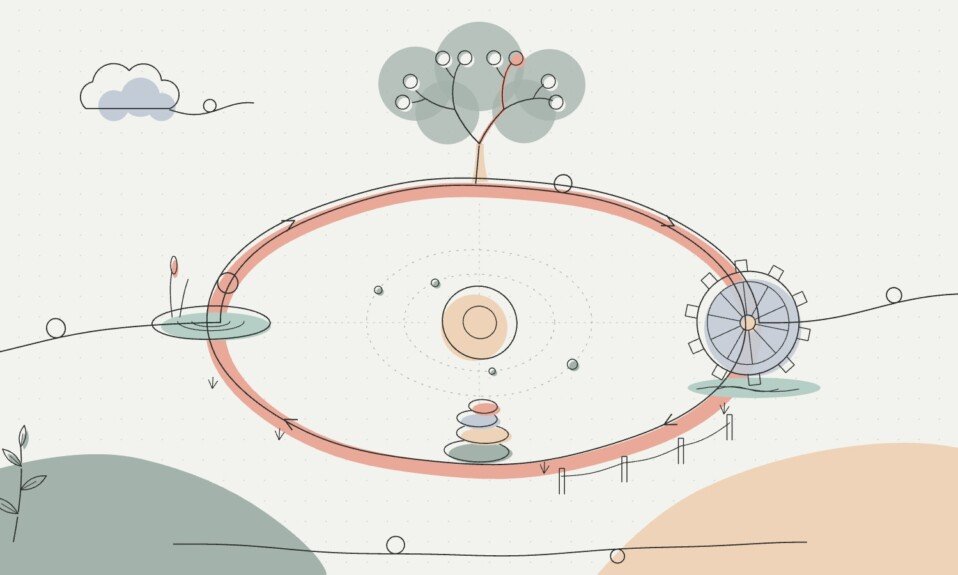
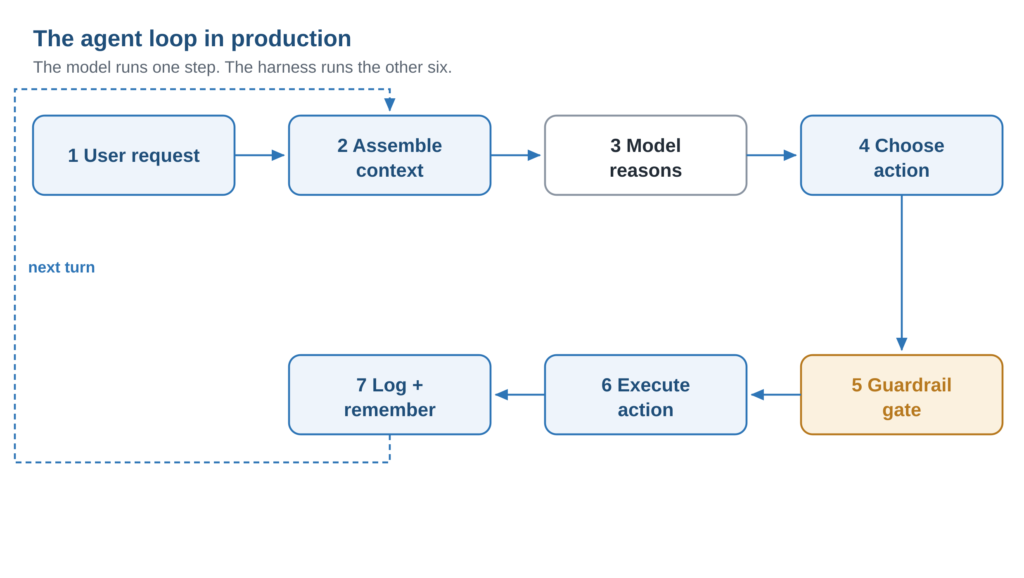
How do these parts fit together? Watch one turn of an agent in production. The user sends a request. The harness assembles the right context. The model reasons over it and chooses an action. Next, a guardrail checks that action. The system executes, logs the result, and updates memory. Then the loop repeats.
Look at where your decisions live. The model performs one step. The harness performs the other six. So most of the design, and most of the risk, sits in the layer you control as a product manager.
Why the harness, not the model, decides outcomes
Now the evidence. The same model, placed in a stronger harness, performs far better. A Stanford study published in March 2026 found performance gaps of up to six times from harness design alone, with the model held constant. The scaffolding changed. The weights did not.
One example makes it vivid. Cursor’s team ran the same Claude model on the same coding benchmark through two different harnesses. One setup scored forty-six percent. The other scored eighty percent. Same weights, same tasks, yet a thirty-four point swing came from the wrapper alone.
I have watched this split play out more than once. A team spends weeks selecting a model, then wires the harness together in an afternoon. The ratio is backwards. That afternoon of work is what users actually feel.
For an AI product manager, the lesson is freeing. You might wait on the next model release to lift quality. Meanwhile, a harness improvement could lift it this quarter, on your own schedule. You do not own the model. You do own the harness.
The four decisions you own as an AI product manager
So what does the discipline ask of you in practice? Four decisions sit at its core. Each one belongs in your specs, not buried inside engineering. To keep them concrete, picture our CRM agent: it updates records, drafts follow-ups, and flags accounts at risk.
Tool and action design — what goes in the requirements
First, decide what the agent can do. The CRM agent could draft an email for review. Or it could send that email on its own. Those are different products with different risk. So list every action in the product requirements, and tag each one by blast radius.
Write the tool descriptions with care, because the model reads them as instructions. A vague description invites misuse. A precise one steers the agent toward the right call. In effect, your requirements teach the agent your domain, one definition at a time.
Guardrails and approval gates — your acceptance criteria
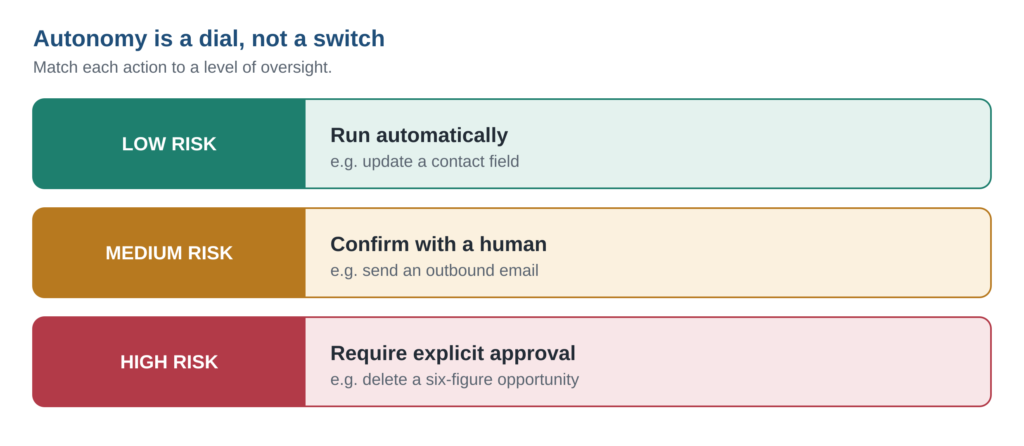
Next, decide where a human steps in. Full autonomy demos well, yet rarely fits enterprise reality. Your buyer cares about control as much as capability.
So write the gates as acceptance criteria. The agent may update a contact on its own. It must pause before deleting a six-figure opportunity. Map each action to a level of oversight, and your user stories gain a clear, testable rule.
Context architecture — a first-class spec decision
Then decide what the agent can see. The rule is unforgiving. If the agent cannot reach something in context, that thing does not exist for it.
The CRM agent needs the account history, the open pipeline, and the current discount policy. Yet it does not need everything at once, because noise crowds out signal. So your spec must name what the agent sees, and when. That is product work, not a data cleanup chore.
Observability — your definition of done
Finally, make the agent legible. Every action should leave a readable trace of input, reasoning, and result. Treat that trace as part of your definition of done, rather than a later add-on.
Observability doubles as your trust story and your roadmap input. When a record changes, you can explain exactly why. And clear logs show where the agent stalls, which tells you what to fix next.
Memory – the basics most teams forget
One component hides in plain sight. Raw models carry no memory between turns. So an agent finishes a task and starts the next with a blank slate. Without help, it forgets what it just did, and that erodes trust fast.
Memory lives in the harness, not the model. You decide what the agent keeps, summarizes, or drops. The CRM agent should recall the last note on an account and carry it across a thread. So treat memory as a product decision, and design the handoffs that make the agent feel coherent.
What breaks when you skip these
These decisions have a mirror image. Skip one, and a predictable failure follows. So read the table below as both a warning and a checklist.
| The decision you own | What breaks if you skip it |
| Tool and action design | Unbounded tools corrupt records fast |
| Guardrails and gates | The agent acts when it should have asked |
| Context architecture | The agent answers from missing or stale data |
| Observability | Nobody can explain what the agent did |
| Memory | The agent forgets and repeats itself |
Each failure starts as a product gap. It becomes an engineering problem only later. So the fixes belong on your roadmap, which brings us to the part the title promised.
How to put harness engineering on your roadmap
Knowing the discipline is not the same as funding it. Leadership wants visible features, and a harness is mostly invisible. So you need a way to make this work legible and fundable. Hence, frame the harness as one epic, not scattered tickets. Give it a clear outcome, such as ‘the agent acts safely and explains itself.’ Then break that epic into the four decisions above, plus memory. Suddenly the work has shape and a backlog.
Sequence it against features honestly. Early on, invest more in gates and observability than in new actions. A narrow agent that users trust beats a broad agent they abandon. So lead with trust, then widen capability once the logs look clean.
Justify the trade with evidence. Point to the sixfold finding and the Cursor swing. Accordingly, explain that a harness fix often beats a model upgrade you cannot control. That argument tends to land with engineering and finance alike.
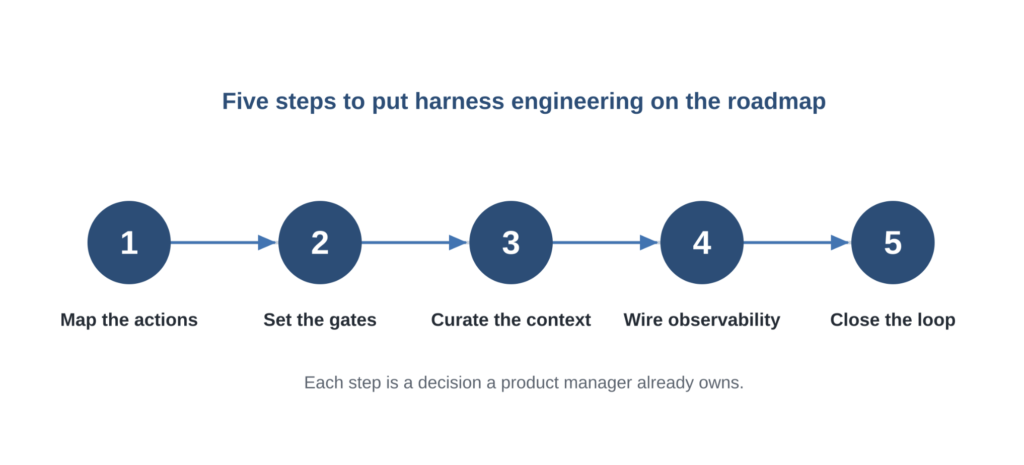
Then run the work as a repeatable cycle, release after release. Map the actions, and set the gates. Curate the context, and wire observability. Finally, close the loop: review the logs each week, and turn what you learn into the next sprint.
Best practices for AI product managers
A few habits separate teams that handle this well from teams that struggle. Altogether, these are the ones I reach for first, and I learned most of them the hard way.
- Write the tool descriptions yourself. They are product copy, and they steer the model more than you expect.
- Start narrow. Ship with tight autonomy, then widen it as trust and logs improve.
- Put every gate in the user story. A hidden approval step erodes confidence and dodges testing.
- Define good with evals before you ship. A small test set turns “it feels better” into a number.
- Budget your context. Treat the prompt as scarce space, not a dumping ground.
- Spec the failure path. Say what the agent does when a tool call fails or data goes missing.
- Keep a human in reach. Design a clean handoff for the moments the agent should not decide alone.
Where to start this week
You do not need a grand initiative to begin. Pick one agent you already ship. Map its actions this week, and tag the riskiest three. Add a gate to each, and a log to all of them. Eventually, that small step alone will change how the agent feels.
Harness engineering will only grow in importance. Eventually, as models converge, the scaffolding around them becomes the real product. So the earlier you build this muscle, the larger your edge becomes later.
Further readings on Harness Engineering
Lee et al. (2026) — Meta-Harness: End-to-End Optimization of Model Harnesses, Stanford, arXiv:2603.28052 — the sixfold harness-driven performance gap.
CORE-Bench, via Vaughan (2026) — same Opus model, 42% on a minimal scaffold vs 78% on a full harness.
Upchurch (2026) — Harness Bench — same model, 100% vs 38% across harnesses.
Frequently Asked Questions around Harness Engineering
What is harness engineering?
It’s the deliberate design of everything that wraps a model — context, tools, control flow, memory, guardrails, and observability. The model supplies raw intelligence. The harness turns that intelligence into a product people can trust. In short, the harness is the layer between the model and the real world.
How is harness engineering different from prompt engineering?
Prompt engineering tunes the words you send the model. It is one ingredient of the harness, not the whole thing. Harness engineering covers the prompt plus context, tools, gates, memory, and logging. So prompt engineering sits inside harness engineering, rather than beside it.
Why does the harness matter more than the model?
Because the same model, in a stronger harness, performs far better. A Stanford study (Meta-Harness, 2026) found performance gaps of up to six times from harness design alone, with the model held constant. Everyone rents the same frontier models, so the harness becomes your real point of difference.
Is harness engineering just another name for agent orchestration?
No. Orchestration frameworks are tools for building a harness. Harness engineering is the set of design decisions you make with those tools — what the agent sees, what it can do, when a human steps in, and how it recovers. The framework is the hammer. The harness is the house.
Whose job is harness engineering — product or engineering?
Both, but the key decisions belong in the product spec. Which actions the agent can take, where a human approves, what context it sees, and what counts as done are product calls with real consequences. Engineering implements them. So an AI product manager owns the decisions, even when engineering owns the code.
How do I start without a big initiative?
Pick one agent you already ship. Map its actions, and tag the riskiest three. Add an approval gate to each, and a log to all of them. That small step alone will change how the agent feels, and it gives you a foothold to build from.
How do I put harness work on the roadmap when leadership wants features?
Frame the harness as one epic with a clear outcome, such as “the agent acts safely and explains itself.” Break it into the decisions you own, then sequence it ahead of new actions. A narrow agent that users trust beats a broad agent they abandon, and that argument tends to win the trade.
Image Courtesy