

Always-on agents act on signals the moment they appear. Learn how product leaders design, govern and measure them, with a worked CRM example.
Most enterprise software still waits patiently for someone to log in. Always-on agents end that dependency. They monitor signals continuously, deliberate within boundaries you define and act the moment conditions change. For product leaders, this is not merely another feature to ship. It is a new operating model for every function your product serves.
Consider an ordinary week. A key customer’s usage slumps on a Friday night. A supplier’s credit rating deteriorates over the weekend. Elsewhere, a renewal window lapses while the account owner is on leave. In each case, the signal was present and the data was available. Yet nobody acted, because nobody was watching.
I call this the Attention Gap: the interval between a signal emerging and someone acting on it. Copilots have not closed it, because a copilot still waits to be summoned. This article defines always-on agents, explains why they matter now and sets out how to design them responsibly. Along the way, it examines a CRM scenario, the evolving role of the AI product manager and a 90-day roadmap.
What are always-on agents?
Always-on agents are software agents that operate continuously, triggered by events rather than by users. They detect changes in data, interpret what those changes signify and act within an explicit mandate. When a decision exceeds that mandate, they escalate it to a person, with the relevant context already assembled.
At first glance, this resembles a copilot. The distinction, however, is fundamental. A copilot is reactive: it assists someone who has already noticed a problem and opened a screen. An always-on agent is anticipatory. It detects the problem first, often hours or days before anyone would have looked.
| Dimension | Copilot | Always-on agent |
|---|---|---|
| Trigger | A user opens a screen and asks | An event, schedule or threshold fires |
| Hours | When the user is working | Around the clock |
| Output | A suggestion or a draft | An action taken, or an escalation with context |
| Governance | The user approves each step | A mandate defines scope, authority and limits |
| Value driver | Faster work | Smaller Attention Gap |
Put simply, copilots make individuals faster. Always-on agents make the entire function responsive, even in the absence of people.
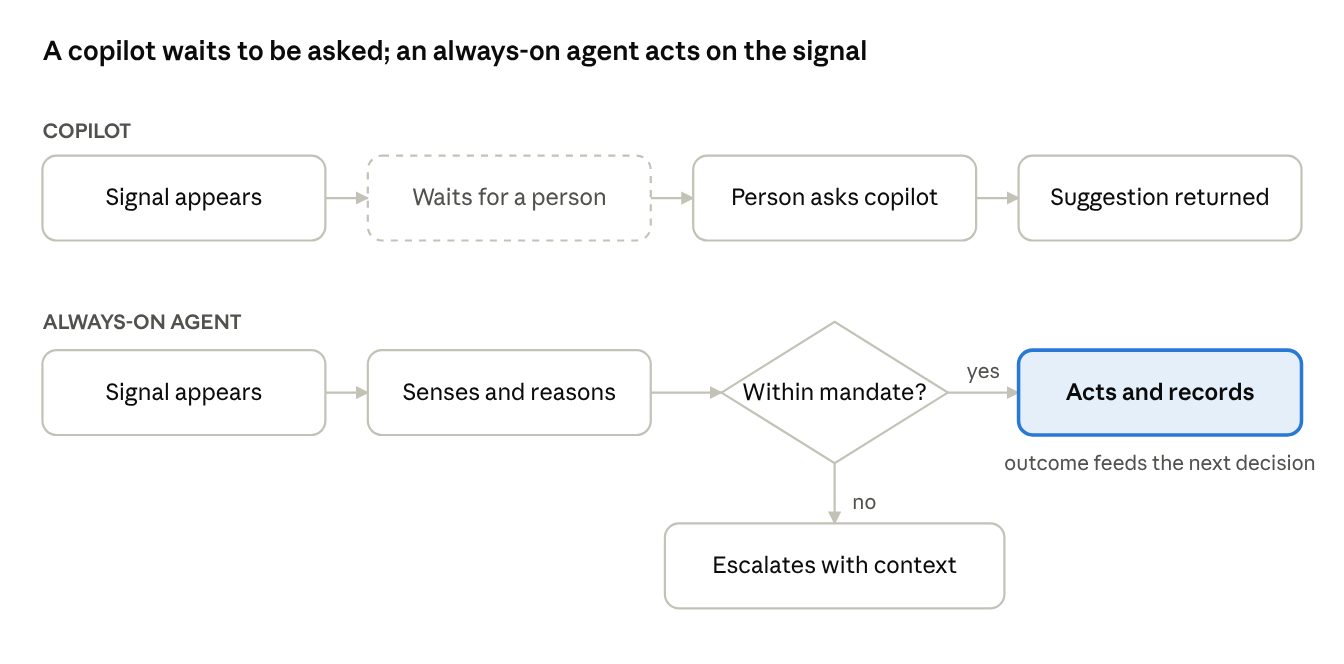
The copilot path stalls until a person happens to notice. The agent path responds immediately and escalates only what lies beyond its mandate.
Inside an always-on agent
Beneath the surface, an always-on agent comprises five stages. Signals rouse it, context reveals what each signal means and reasoning determines the appropriate response. A mandate check then confirms the action is permissible before the agent acts or escalates. Every step is logged, so both the agent and its supervisor can learn from the outcome.
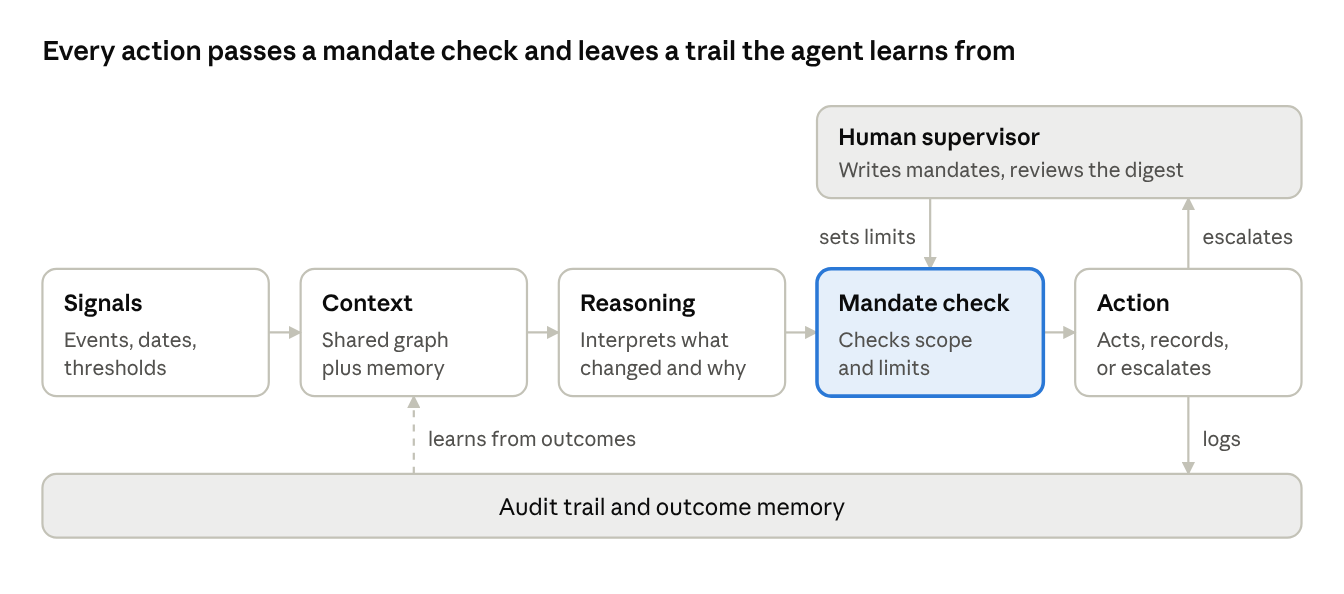
The mandate check is the decisive control point. It is where the business, rather than the model, determines what the agent may do.
Why enterprise functions need always-on agents now
The transition is already under way. Gartner forecasts that 40% of enterprise applications will embed task-specific AI agents by the end of 2026, up from less than 5% in 2025. It further predicts that agentic AI will make at least 15% of day-to-day work decisions autonomously by 2028.
Sales organizations are moving fastest. According to Salesforce’s latest State of Sales research, nine in ten sales teams already use agents or expect to within two years.
The early evidence on outcomes is encouraging, yet instructive. A widely cited NBER study found that an AI assistant lifted customer support productivity by 14% on average, and by 34% for novice workers. Klarna pushed further still. In early 2024, it reported that its AI assistant was handling two-thirds of customer service chats and had cut resolution times from 11 minutes to 2. By May 2025, however, its CEO acknowledged that the company was hiring human agents again, because quality had suffered.
That reversal is the more consequential story. Speed and scale are easy to demonstrate within a quarter. Quality, trust and a graceful handoff to people are what make the gains endure.
The data also carries a sober warning. Gartner expects more than 40% of agentic AI projects to be canceled by the end of 2027. It attributes this to escalating costs, unclear business value and inadequate risk controls. It also estimates that only about 130 of the thousands of vendors claiming agentic capabilities are genuine.
For product leaders, the implication is unmistakable. Bolting an assistant onto every screen will not survive that shakeout. Instead, the enduring products will run continuously, act on genuine signals and prove their worth in measurable outcomes.
A CRM example: always-on agents and the account that went quiet
To ground this in practice, consider an illustrative B2B software company. One of its largest accounts renews in 90 days. On a Thursday night, three seemingly unrelated signals arrive within a few hours of one another.
- Product usage in the account falls 35% week over week.
- The customer’s internal champion updates her profile to reflect a new employer.
- Two senior stakeholders from the account visit the competitor comparison page on the vendor’s website.
In a conventional CRM, each signal lands in a separate system. The usage dip sits unnoticed in a product analytics dashboard. Similarly, the job change surfaces only if someone happens to spot it. The web visits languish in a marketing report until the next weekly review. By the time the account owner connects the dots, the customer may already be evaluating alternatives.
Now replay the same night with an always-on agent. Within minutes, it correlates all three signals and recognizes a classic renewal-risk pattern. It then acts decisively, but strictly within its mandate:
- Elevates the account’s health risk score and records the supporting evidence in the CRM.
- Identifies the champion’s probable successor from recent meeting and email activity.
- Drafts a personalized introduction from the account executive to that successor.
- Assigns the customer success manager a task to review usage with the customer.
- Proposes an executive sponsor call and identifies open slots in both calendars.
Crucially, the agent neither offers a discount nor alters contract terms. Those decisions lie outside its mandate, so it escalates them. When the account executive arrives on Friday, a concise brief is waiting. It explains what happened, what the agent has already done and which two decisions require human judgment.
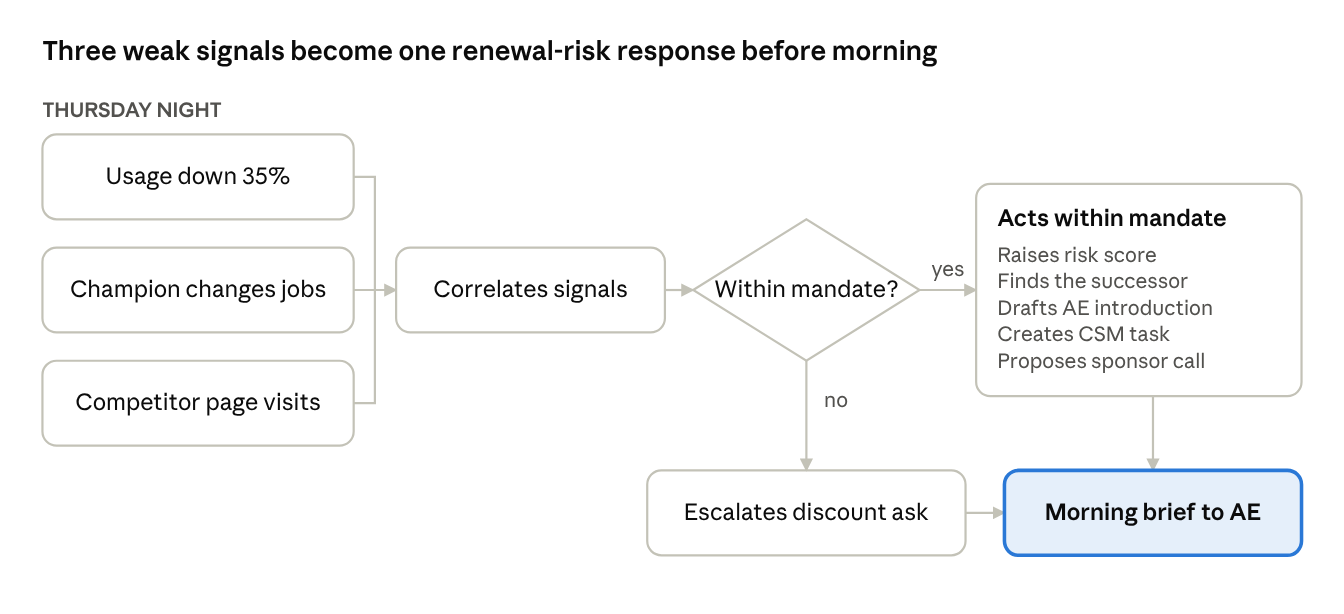
Routine actions are completed overnight within the mandate. Commercial decisions are escalated, and both paths converge in a single brief for the account executive.
Where CRM vendors already stand
None of this is speculative. Salesforce, HubSpot and Microsoft already ship agent platforms within their CRMs. The agents themselves are no longer the hard part. Instead, the gap lies in what surrounds them: who authors the mandate, which decisions an agent may take alone and how its actions are audited.
That gap is a product problem, not a model problem. It is also where product leaders can differentiate decisively, whether they build on a platform or compete against one.
A note on data and consent
Signals such as a job change or a website visit raise legitimate privacy questions. Therefore, an always-on agent should draw only on consented sources, such as licensed enrichment providers and opted-in website tracking. It should never scrape personal profiles. Moreover, regulations such as the EU AI Act require that people know when they are interacting with an AI system. Accordingly, disclosure belongs in every outreach template an agent may send.
What the mandate looks like
The agent’s conduct is governed by a mandate, not a prompt. A mandate is a standing instruction that a business owner authors, approves and periodically reviews. In this scenario, it might read as follows.
| Element | Example |
|---|---|
| Objective | Protect renewal revenue in enterprise accounts |
| Scope | Accounts above $100,000 in annual recurring revenue renewing within 180 days |
| Authority | Update risk fields, create tasks, draft outreach, propose meetings |
| Limits | No pricing, discount or contract changes; no external email sent without approval |
| Escalation | Account executive within four business hours; sales director if unanswered |
| Review | Monthly review of actions taken, overrides and outcomes |
As trust accrues, the mandate can broaden. The agent might eventually send approved check-in emails without review, but only after its drafts have been accepted unchanged for several months.
Five design principles for always-on agents
The CRM scenario succeeds because of choices made long before that Thursday night. Agentic products I have led are now live at more than 35 enterprises. That experience has distilled five principles that separate durable always-on agents from impressive demonstrations.
1. Design for triggers, not screens
Begin with the events that matter, not the interface. Enumerate the signals that should rouse an agent: a threshold breached, a deadline approaching, a document arriving or a pattern emerging. Then determine which signals warrant action and which merely warrant a record. Most products neglect this step, because they were architected around user sessions.
2. Write mandates, not prompts
A prompt solicits a single answer. A mandate, by contrast, is a standing commitment with an objective, scope, authority, limits and an escalation path. Mandates give business owners something they can read, approve and audit. Consequently, they elevate agent behavior from a technical detail to a governed business decision.
3. Earn autonomy one decision class at a time
Autonomy should never be granted to an entire workflow at once. Instead, decompose the work into decision classes, such as updating a field, drafting an email or approving a spend. Each class then ascends a ladder: observe, recommend, act on approval, act and notify, and finally act autonomously. Promotion should rest on evidence, such as override rates and outcomes over a defined period.
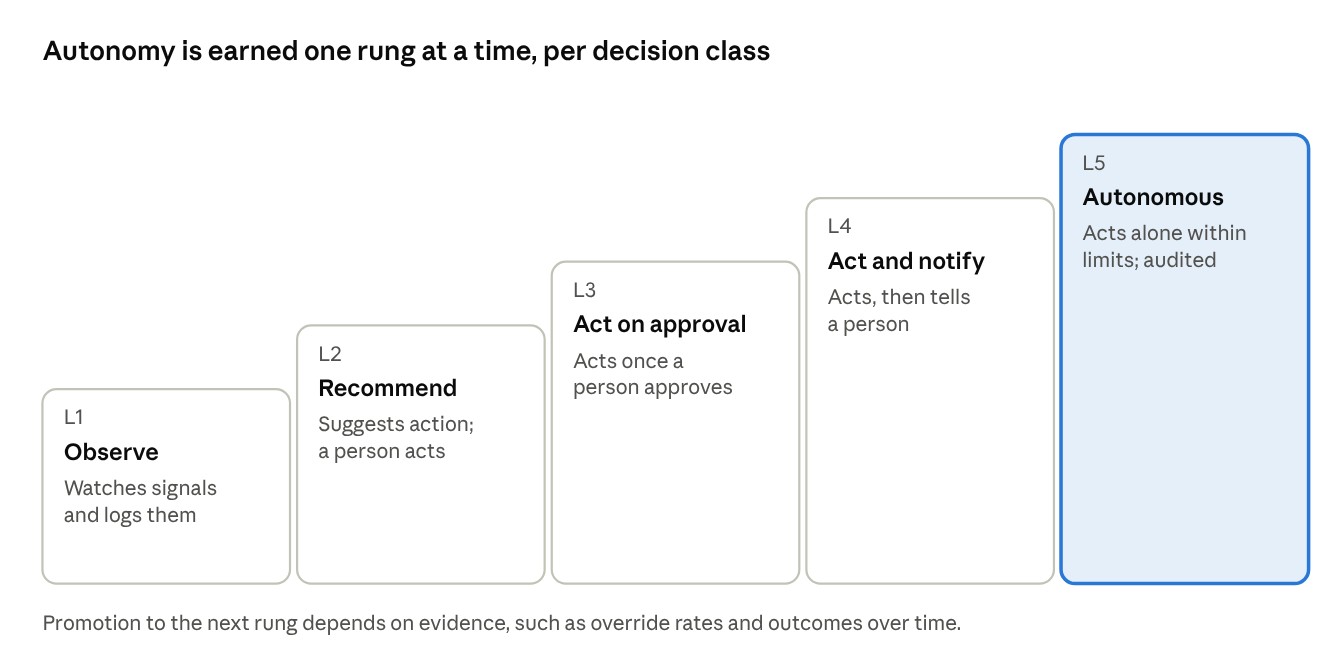
Different decision classes occupy different rungs simultaneously. Updating a CRM field may be fully autonomous, while sending an external email still requires approval.
4. Give agents shared context and memory
An agent confined to one system will make myopic decisions. Therefore, connect customers, contracts, products and people in a shared context layer, often a knowledge graph. Add memory of past actions and their consequences, so the agent learns which interventions genuinely work. Without it, every signal is treated as though it were the first.
5. Make every action explainable and reversible
Trust is a function of transparency. Every action should record what triggered it, what the agent knew, which rule permitted it and how to reverse it. In addition, build circuit breakers that pause an agent when error rates or volumes spike. These safeguards belong in place before the first agent goes live, not after the first incident.
How to measure always-on agents
Usage metrics alone cannot justify always-on agents. Daily active users and prompts per session describe a copilot, not an agent that works while users are away. Instead, measure how swiftly the function responds, how much the agent accomplishes on its own and whether its actions create value.
| Metric | What it measures | CRM example |
|---|---|---|
| Signal-to-action time | Hours between a signal appearing and the first action | Time from usage drop to outreach drafted |
| Autonomous action share | Share of actions completed without human approval | Risk updates and tasks created by the agent |
| Override rate | Share of agent actions changed or reversed by people | Drafts edited heavily or discarded |
| Escalation quality | Share of escalations people agree needed a human | Discount requests correctly routed |
| Outcome value | Business result attributable to agent actions | Renewal revenue retained in flagged accounts |
| Cost per decision | Compute and platform cost per action taken | Inference cost per account monitored |
Together, these metrics form a narrative that executives readily understand. They capture speed, scale, quality and return in a single view. Above all, they tie agent activity to the outcomes for which a function is accountable.
Where always-on agents go wrong
Even well-funded programs falter in predictable ways. Recognizing these patterns early is among the most valuable contributions a product leader can make.
- Agent-washing. Teams rebrand existing automation or chat features as agents. Customers see through it quickly, and credibility erodes.
- Alert fatigue. Agents surface every signal instead of acting on the consequential ones. People soon ignore the agent altogether.
- Autonomy without evidence. Leaders confer broad authority after a single successful pilot. One visible misstep then sets the entire program back.
- Data perfectionism. Teams defer action until a complete master-data program is finished. Meanwhile, competitors learn from real deployments.
- Invisible value. Products track activity but not outcomes. When budgets tighten, nobody can demonstrate that the agent paid for itself.
- Cost surprises. Continuous monitoring consumes compute around the clock. Without a cost-per-decision view, margins erode silently.
Each of these failures is avoidable when always-on agents are built as products, not projects. Most stem from treating agents as a feature rather than as a governed operating model.
What always-on agents change for product teams
Most commentary on agents dwells on models and use cases. For product leaders, however, the more demanding questions lie elsewhere. Four of them merit attention before the first release.
Pricing: from seats to outcomes
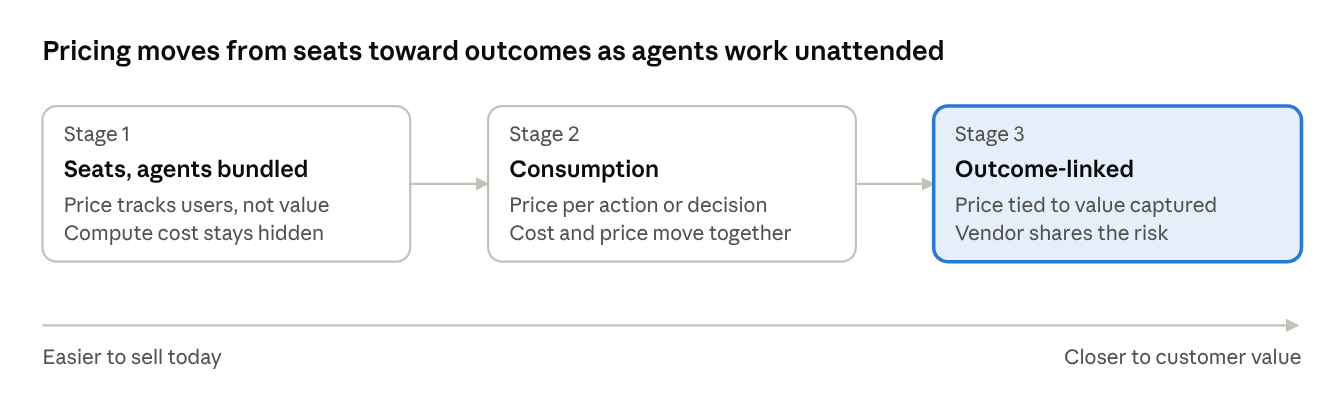
An always-on agent does its finest work when nobody is logged in. As a result, per-seat pricing ceases to reflect value, and it conceals a genuine cost. Continuous monitoring consumes compute around the clock, whether or not anyone is watching.
Most vendors will progress through three stages. First, they will retain seats and bundle agents in. Next, they will introduce consumption pricing per action or decision. Finally, the most confident will tie price to outcomes, such as revenue retained or savings captured. Whichever stage you choose, model your cost per decision early. Otherwise, your most loyal customers may become your least profitable.
Supervision: design the human side first
The most consequential screen in an agent product is not the agent’s. It is the supervisor’s. Anyone overseeing always-on agents needs a concise daily digest, an exception inbox and a mandate editor. They also need a one-click override that captures the rationale behind every change.
Those override rationales are invaluable. They are the most economical evaluation data you will ever collect. Moreover, they reveal precisely where a mandate is too broad or too narrow.
Evaluation: test before you trust
Circuit breakers contain failures in production. They do not, however, prove that an agent deserves more authority. For that, you need a rigorous evaluation pipeline that runs before every promotion.
Begin by replaying historical cases with known outcomes. Then run the agent in shadow mode against live signals. Next, red-team it with adversarial inputs, such as an email crafted to manipulate the agent. Finally, rerun the entire suite whenever the model, prompts or policies change.
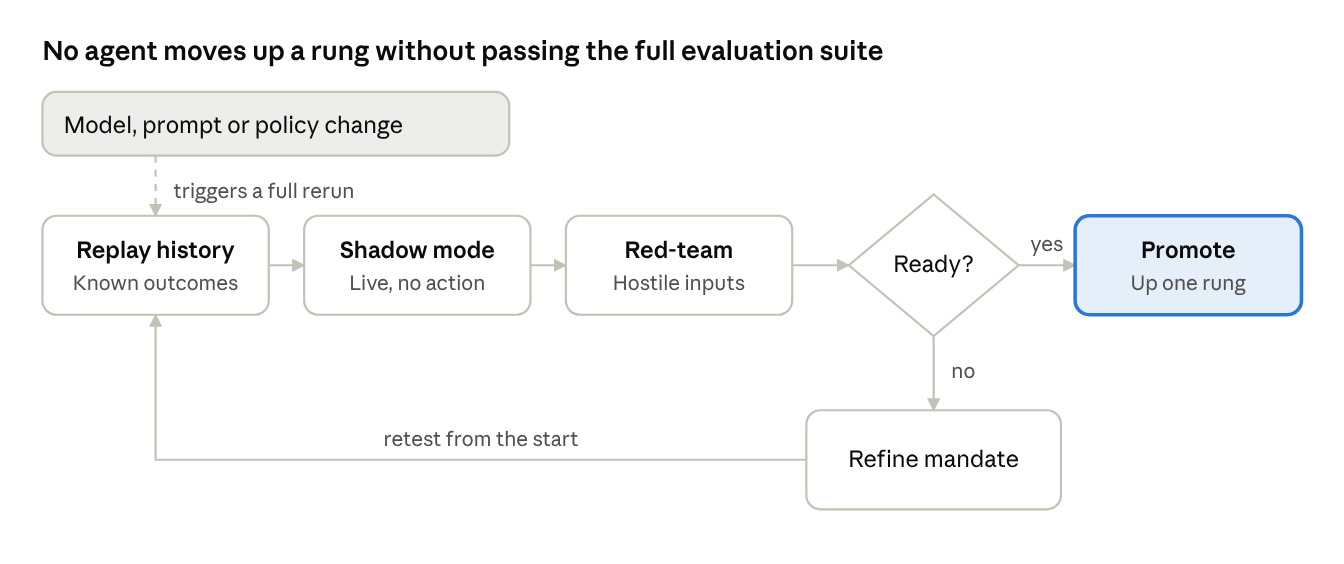
A failed test returns the mandate for refinement. Any change to the model, prompts or policies restarts the suite from the beginning.
Requirements: the PRD changes too
A traditional product requirements document describes screens and flows. A PRD for always-on agents must also specify how the product behaves when nobody is watching.
| Traditional PRD | PRD for always-on agents |
|---|---|
| User stories and flows | Triggers, signals and decision classes |
| Screen designs | Supervisor digest, inbox and override design |
| Acceptance criteria | Evaluation suite and promotion thresholds |
| Permissions by role | Mandates with scope, authority and limits |
| Error states | Escalation paths, circuit breakers and kill switch |
| Usage analytics | Signal-to-action time, override rate and outcome value |
What changes for AI product managers
The most profound change is not in the product. It is in the product manager’s own remit. Always-on agents blur the boundary between product and operations. As a result, the AI product manager now answers for how the product behaves in production, around the clock, not merely for what ships at launch.
From feature owner to behavior owner
In a traditional SaaS product, a feature is complete once it ships. Users decide what to do with it. With always-on agents, the product itself decides and acts. Consequently, the AI product manager becomes accountable for those decisions, including the ones made at 2 a.m.
This shift permeates almost every facet of the role. The comparison below shows where the work migrates.
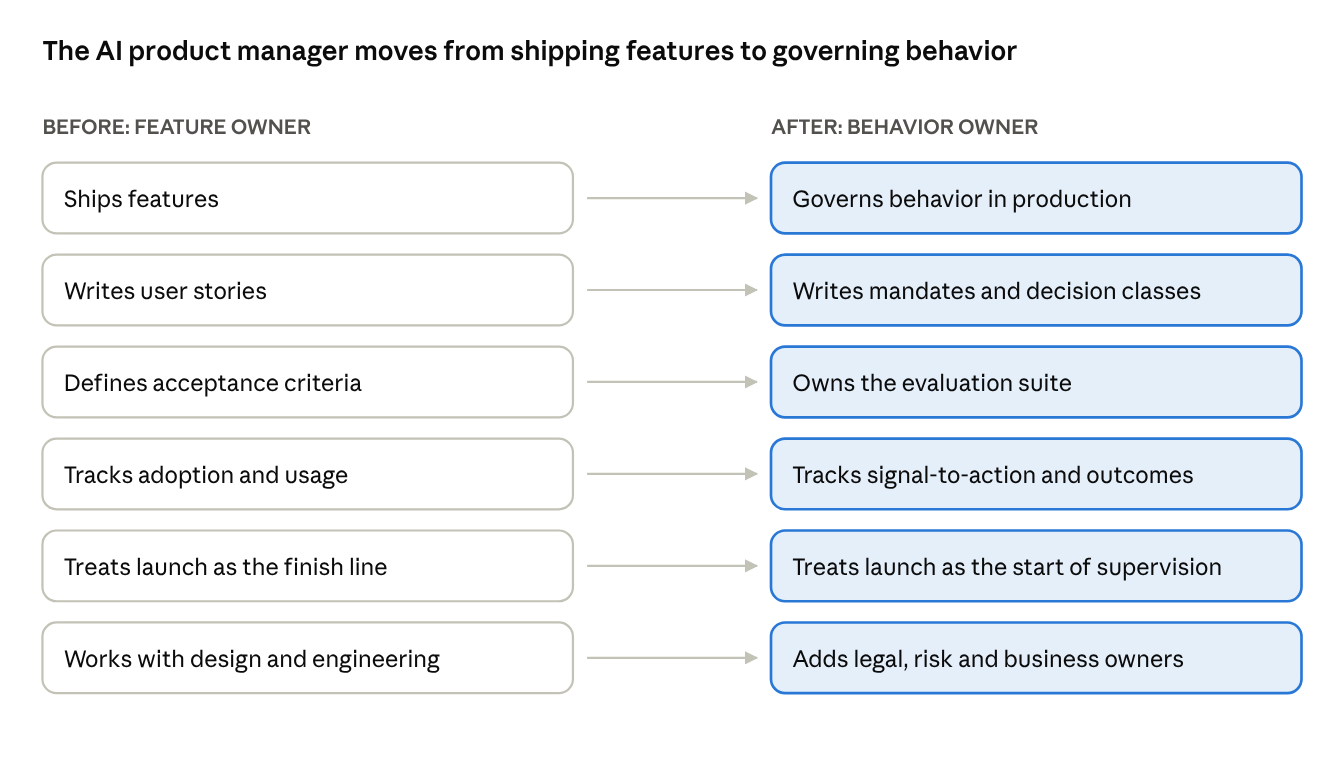
None of the established work disappears. Discovery, prioritization and stakeholder management remain essential. However, they now coexist with a second discipline: stewarding the agent as a live system.
A day in the life, before and after
The clearest way to grasp the change is to compare two days. The schedules below are illustrative, yet they reflect how the work tends to evolve.
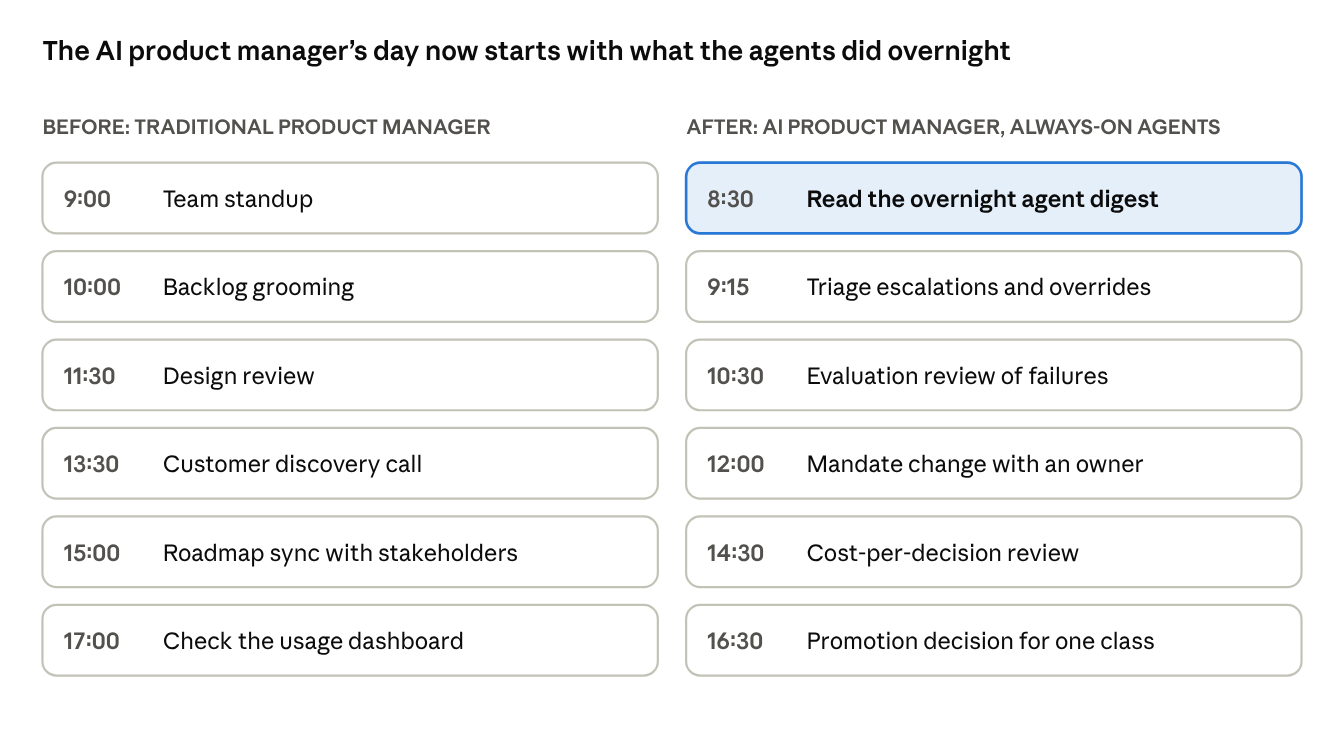
The new day begins with the overnight digest, not with standup. Before the first meeting, the AI product manager reviews what the agents did while the team slept. They scan the escalations, the overrides and any circuit breakers that tripped.
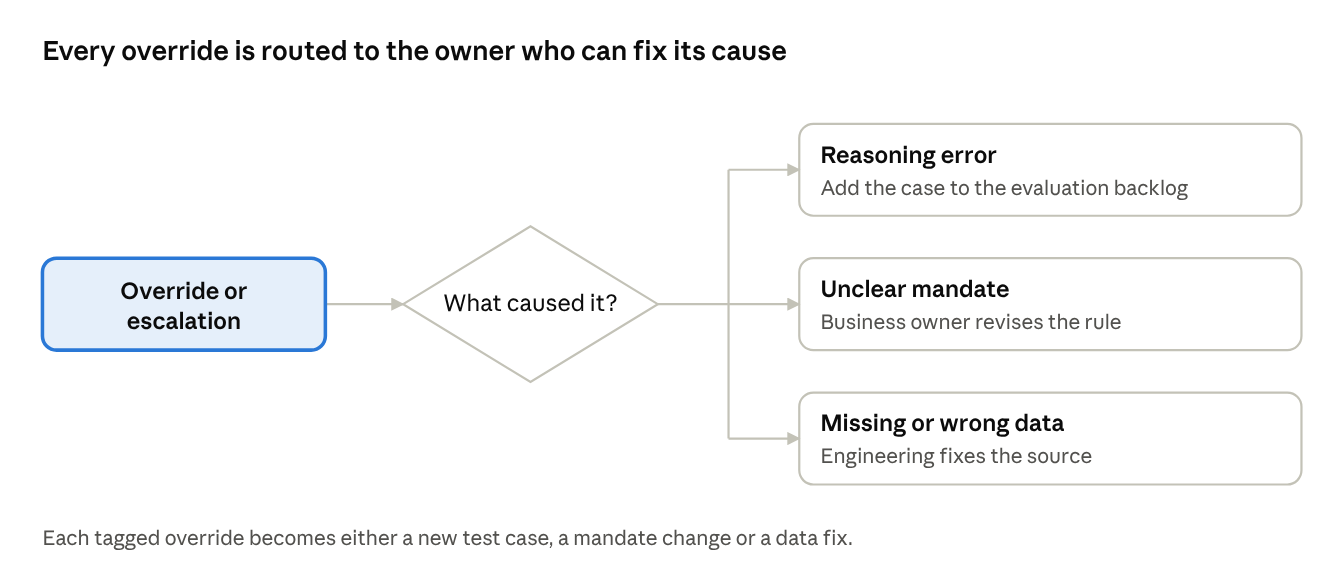
Triage follows. Every override is a signal in its own right. Either the agent erred, the mandate was ambiguous or the data was incomplete. The product manager diagnoses the cause and routes it accordingly: a data issue to engineering, an ambiguous rule to the business owner, a reasoning failure to the evaluation backlog.
Later in the morning, the evaluation review supplants much of the old backlog grooming. Failed cases from production become new test cases. As a result, the evaluation suite grows from real incidents rather than from conjecture.
After lunch, attention turns to mandates and margins. A business owner may wish to raise a spend limit or extend coverage to a new account segment. The product manager drafts the amendment, tests it against past cases and schedules it for approval. They also scrutinize cost per decision, because an agent that monitors every account every hour can quietly become expensive.
The day often concludes with a promotion decision. Has a decision class earned the next rung on the autonomy ladder? The answer rests on evidence, not enthusiasm.
The new operating rhythm
Daily habits require a weekly and monthly scaffold. The rituals below give always-on agents a predictable governance cadence.
| Ritual | Cadence | Who attends | Output |
|---|---|---|---|
| Overnight digest review | Daily | Product manager, supervisors | Escalations triaged, anomalies flagged |
| Override review | Weekly | Product manager, business owner, supervisors | Mandate changes and new test cases |
| Evaluation review | Weekly, and on every model or prompt change | Product manager, ML engineer, QA | Suite results and a regression list |
| Cost and margin review | Every two weeks | Product manager, finance, engineering | Cost per decision against target |
| Autonomy council | Monthly | Product manager, business owner, risk, legal | Promotions, demotions and register updates |
| Customer value review | Quarterly | Product manager, customer, customer success | Outcome value against the baseline |
The artifacts AI product managers now own
Roadmaps and PRDs endure, but they no longer suffice. An AI product manager stewarding always-on agents should also own the following artifacts:
- Mandate library: every active mandate, with its owner, version history and approval record.
- Decision-class map: each decision the agent can make, and the rung it currently occupies.
- Autonomy register: the auditable record of who granted which authority, when and on what evidence.
- Evaluation suite: a curated corpus of historical cases, adversarial inputs and promotion thresholds.
- Escalation playbook: who receives each type of escalation, and how swiftly they must respond.
- Cost model: compute, platform and human review cost per decision, by decision class.
- Supervisor experience specification: the digest, inbox, override and mandate editor that people rely on daily.
- Incident postmortems: a blameless account of every significant agent error and the remedy that followed.
Working with new partners
Always-on agents draw new stakeholders into the product conversation. Legal, risk and the business owners of each function now hold a direct stake in how the product behaves. Clear ownership forestalls both gaps and turf wars.
| Activity | AI product manager | Engineering and ML | Business owner | Legal and risk |
|---|---|---|---|---|
| Define decision classes | Owns | Consulted | Consulted | Consulted |
| Write and approve mandates | Drafts | Consulted | Approves | Consulted |
| Build the evaluation suite | Owns | Builds | Consulted | Informed |
| Promote a decision class | Proposes | Consulted | Approves | Consulted |
| Respond to an agent incident | Owns | Fixes | Informed | Consulted |
| Set pricing and cost targets | Owns | Consulted | Informed | Informed |
The skills to build
The most accomplished AI product managers I work with are cultivating six capabilities that traditional product roles seldom demanded.
- Systems thinking. They model events, signals and state, not merely screens and flows.
- Evaluation literacy. They can design a test set, interpret precision and recall, and orchestrate a red-team exercise.
- Inference economics. They understand what each decision costs and how model choice reshapes margin.
- Policy craftsmanship. A mandate is a policy, so they write precise, testable rules in plain language.
- Regulatory fluency. They anticipate what auditors and regulators will ask, and design for it from the outset.
- Operational composure. They remain calm in an incident, lead a blameless postmortem and fix the system, not the symptom.
Mistakes to avoid
Even accomplished product managers stumble when they first assume ownership of always-on agents. These are the pitfalls I encounter most often.
- Treating launch as the finish line. For agents, launch marks the beginning of supervision.
- Measuring prompts instead of outcomes. Usage metrics flatter agents. Outcome value tells the truth.
- Owning the model but not the mandate. Model choice matters far less than the rules governing the agent.
- Delegating evaluation to engineering. The product manager defines what good looks like, so they must own the test set.
- Obscuring cost on the roadmap. Every new signal and every additional check carries a price. Make it visible.
- Neglecting the supervisor experience. If oversight is cumbersome, people simply stop doing it.
Your first 30 days on an agent product
If you are stepping into this role, begin with the system as it operates today. Then refine it, one decision class at a time.
- Review the last 30 days of escalations and overrides, and diagnose the cause of each.
- Map every decision class and the autonomy rung it currently occupies.
- Shadow a supervisor for a full shift to experience the digest and inbox as they do.
- Audit the evaluation suite, and add the ten most recent production failures as test cases.
- Build a straightforward cost-per-decision view by decision class.
- Bring one promotion and one demotion, each substantiated by evidence, to the next autonomy council.
A 90-day roadmap for product teams
A multi-year program is not a prerequisite. A focused team can demonstrate value within a single quarter, provided it advances four workstreams in concert: product, data, governance and change. Most failed pilots advance only the first two. As a result, they produce a functioning agent that nobody trusts or supervises.
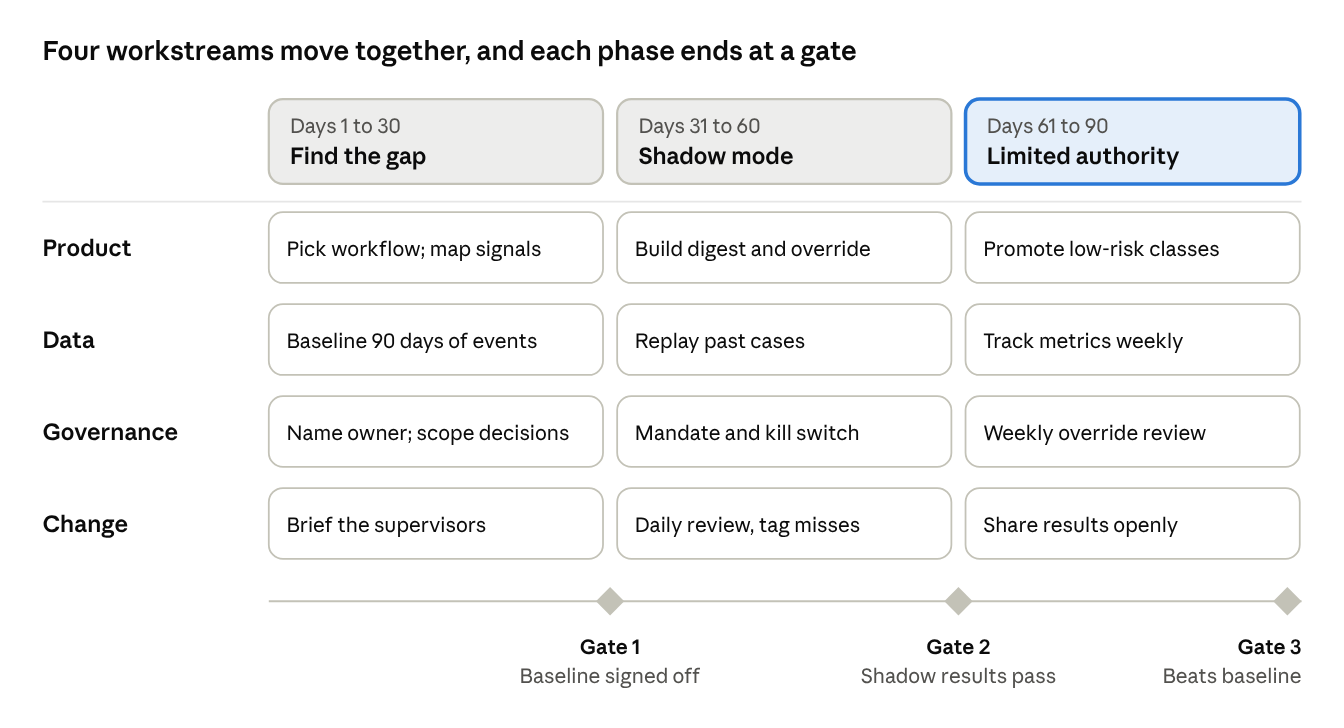
All four workstreams advance in lockstep. No phase begins until the preceding gate has been cleared.
Days 1 to 30: find the Attention Gap
The first month’s objective is a baseline that the business owner genuinely believes.
- Product: Select one function and one high-value workflow, such as renewals in CRM. Then map its signals and decision classes.
- Data: Sample the last 90 days of events. Record when each signal emerged, when someone acted and what value was lost.
- Governance: Appoint a business owner and agree which decision classes an agent may touch.
- Change: Brief the people who will supervise the agent, and agree how success will be judged.
Gate 1: The business owner endorses the baseline and the business case.
Days 31 to 60: ship one mandate in shadow mode
The second month’s objective is evidence that the agent would have made sound decisions.
- Product: Build the supervisor digest and override flow before granting any autonomy.
- Data: Connect only the sources the mandate requires. Then replay historical cases through the agent.
- Governance: Author the mandate, set escalation timeframes and test the kill switch.
- Change: Supervisors review recommendations daily and flag every disagreement.
Gate 2: Shadow recommendations meet the agreed accuracy threshold, with no critical errors.
Days 61 to 90: grant limited authority and measure
The third month’s objective is a measured result against the baseline.
- Product: Promote the lowest-risk decision classes to act-on-approval or act-and-notify.
- Data: Track signal-to-action time, override rate, outcome value and cost per decision every week.
- Governance: Review every override and escalation in a weekly session with the business owner.
- Change: Share results candidly with stakeholders, including what went wrong.
Gate 3: Results surpass the baseline at an acceptable cost per decision.
Exit criteria at each gate
Gates are only meaningful if the team agrees, in advance, on the consequence of missing one.
| Gate | Question it answers | Evidence required | If the gate is missed |
|---|---|---|---|
| Gate 1 (day 30) | Is the gap worth closing? | A signed-off baseline of response time and value lost | Choose a different workflow |
| Gate 2 (day 60) | Is the agent right often enough? | Shadow results that meet the agreed threshold, with no critical errors | Extend shadow mode and refine the mandate |
| Gate 3 (day 90) | Does it pay? | Gains against the baseline, a falling override rate and cost within target | Hold the autonomy level, or stop |
Beyond day 90: from one mandate to a portfolio
A successful quarter earns the right to scale, not the license to switch everything on. Between days 91 and 180, expand to three mandates within the same function. In parallel, promote proven decision classes and begin building a shared context layer.
Between days 181 and 365, bring a second function onto the same context layer and governance model. By then, the most mature decision classes in the first function may operate autonomously, with the autonomy register under internal audit review.
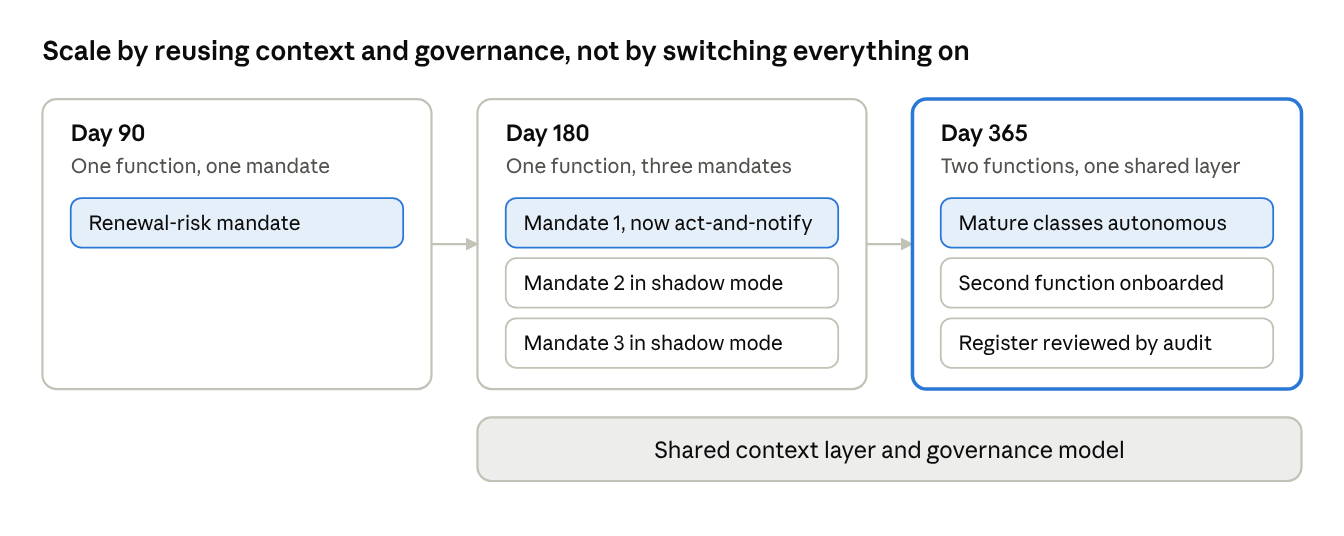
The goal at day 365 is not a single ingenious agent. Rather, it is a repeatable system for converting mandates into governed autonomy, one function at a time.
Conclusion: always-on agents are an operating model
Always-on agents will not be judged by how eloquent they sound. Instead, they will be judged by how swiftly a function responds and how much value it captures while people sleep. For product leaders, the work concerns mandates, evidence and trust far more than models.
The functions that move first will not simply be more efficient. They will be organized differently, with teams that govern decisions rather than process transactions. The question is no longer whether this shift will occur. Rather, it is whether your product leads it or follows it.
Download the eBook
This article sets out the playbook. My eBook, The Procurement Function That Never Sleeps, attached below, demonstrates it end to end within a single function. It covers a complete mandate framework, the autonomy ladder in practice, a year-one business case and a 90/180/365-day plan for source-to-pay. Procurement is the worked example, yet the frameworks translate readily to sales, service, finance and HR.
Sources
- Gartner: 40% of enterprise apps will feature task-specific AI agents by 2026 (August 2025)
- Gartner: over 40% of agentic AI projects will be canceled by end of 2027 (June 2025)
- Salesforce State of Sales report (2026)